Enjoy a Complete, Healthy Smile
Cost is the most common reason patients delay bridge work. We make sure to clearly consider finances with each patient before treatment starts.
Bridges are usually at least partially covered by dental insurance because they restore function as well as appearance. Our dentist in Baltimore, MD, accepts most insurance plans, and our team will help you take full advantage of your eligible benefits. Insurance often covers a meaningful portion of the cost of a traditional bridge; coverage on implant-supported bridges varies more by plan because the implant surgery component is treated differently across carriers.
For patients who want to spread out-of-pocket expenses into manageable monthly payments, we accept CareCredit financing. CareCredit offers low-interest and no-interest loan options depending on the applicant and the plan length.
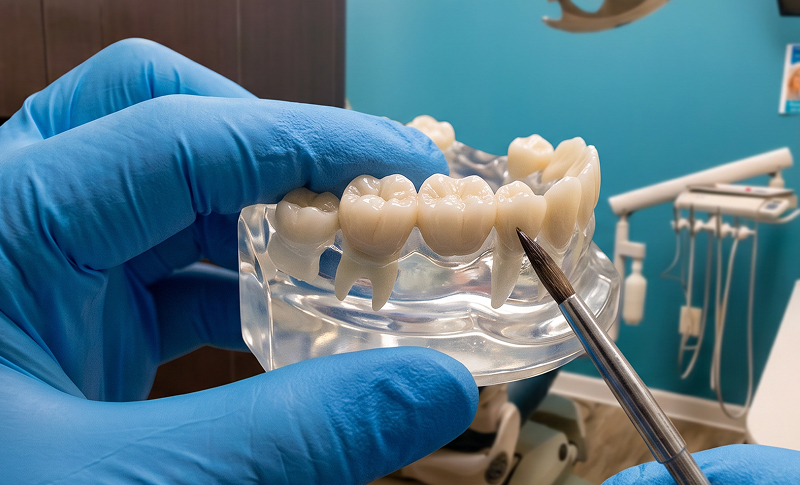
A dental bridge is a row of artificial teeth, called pontics, that span the gap in your smile and are anchored by a crown. They can be designed to replace a single missing tooth or a row of teeth.
Drs. Mohamed Saccoh and Kheri-Ann Robinson at Family, Cosmetic & Implant Dental Care in Joppa, MD, create beautiful bridges using high-end IPS e.max, which offers optimal translucency and durability for stunning results.
Unlike many practices, the dentists at Family, Cosmetic & Implant Dental Care in Joppa, MD, have the advanced training and sophisticated technology to offer a full range of dental bridges to meet our patients' varied needs. We offer both traditional bridges and implant-supported bridges and can provide all the services needed for your bridge at our practice so you don't have to go from place to place for dental care.
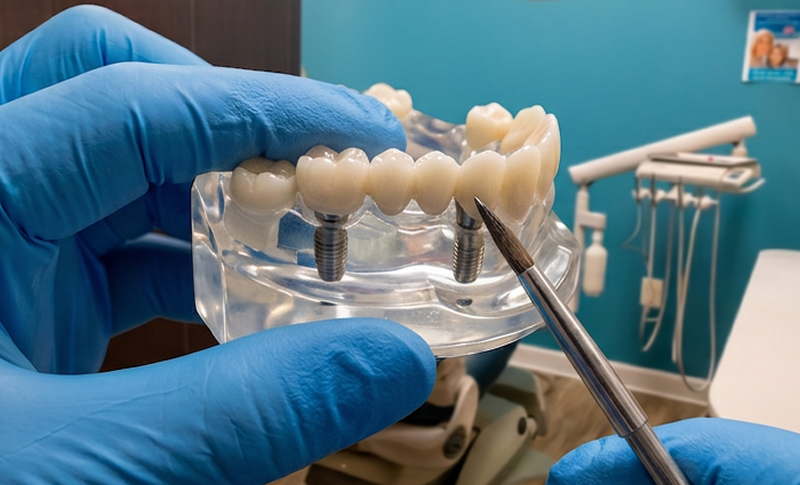
A traditional bridge has two crowns at either end of the bridge with pontics (false teeth) in between. The crowns are attached to nearby natural teeth that are reshaped to hold them. A traditional bridge can typically hold up to three pontics, but is not recommended for longer stretches of missing teeth.
Candidacy: Traditional bridges are a good fit for patients whose adjacent teeth are healthy enough to support crown anchors and whose budget or timeline favors a faster, lower-cost solution. They are typically the right choice for shorter spans of missing teeth in patients who have sufficient bone health.
Dental implants are small posts that can be inserted into the jaw to support a dental bridge. Implant-supported bridges can span longer stretches of missing teeth than a traditional bridge. Since implant-supported bridges are self-supporting, they do not require altering nearby teeth for support.
Candidacy: Implant-supported bridges are the preferred long-term option because the implants stimulate the jawbone and prevent the bone loss that follows tooth loss. They are typically the right choice for patients who want to preserve bone health, who do not want to reshape adjacent natural teeth, or who are replacing longer spans of missing teeth.
If you are missing only one tooth, you can fill the gap with a dental implant and a dental crown instead of an entire bridge. Implants are the preferred method to replace a single missing tooth since the implant stimulates bone growth in the tooth socket.
While the implant process takes longer than getting a conventional bridge, many patients feel the implant's oral health benefits are worth the extra time. We also offer complete smile makeovers to address a range of concerns.
Traditional bridges are a fast, affordable solution to missing teeth. However, patients looking to shore up their long-term oral health can benefit from an implant-supported bridge, which stimulates bone growth in the jaw, keeping it strong.
Your choice in a dental bridge may also be dictated by conditions in your mouth, such as the strength of neighboring teeth and the condition of your jaw.
To get all the information you need to make an informed decision, request a consultation at Family, Cosmetic & Implant Dental Care in Baltimore, MD, with one of our dentists, Drs. Mohamed Saccoh and Kheri-Ann Robinson. Our dentist can examine your mouth, discuss your goals, and give an expert recommendation based on your needs.
Traditional dental bridges have a quick turnaround and can usually be placed in just two office visits. Here is what each step in that timeline looks like:
We craft dental bridges out of high-end dental materials, such as IPS e.max®, for beautiful, long-lasting results.
If you have several teeth that are failing or if you are missing a number of teeth, you might be on the fence as to what to do. Dr. Saccoh can perform an overall assessment of your mouth and map out different dental scenarios for you to think about. In addition to bridges, you may want to consider dentures or partial dentures.
The team at Family, Cosmetic & Implant Dental Care provides comprehensive treatments using state-of-the-art technology so that you and your family can enjoy beautiful and healthy smiles. Our dentists are members of professional associations including:
To schedule an appointment at our Joppa, MD, dentist office, contact us online or call (410) 679-4500.